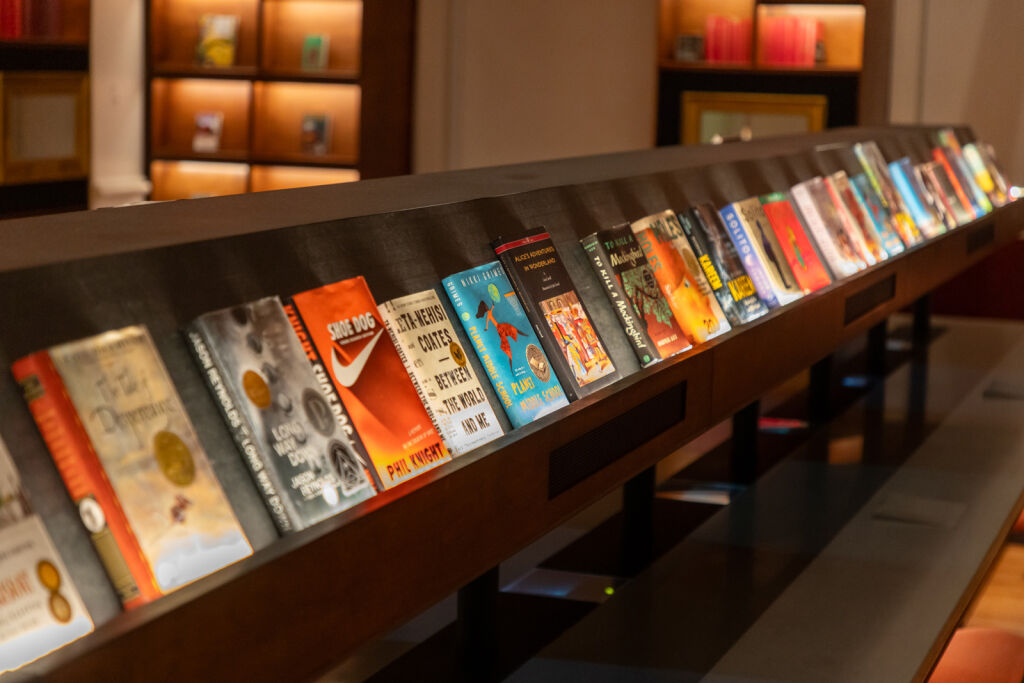
Will Homer Save Us?
Have we become a post-literate society? That’s the debate currently agitating historians, journalists, English teachers, and reading researchers. (Or, should I say, the debate that is raging once again, since you could argue that the same debate has been raging ever since radio and television came on the scene and allowed people to learn and be entertained without burrowing into a book.)
The August cover story by Rose Horowitch in The Atlantic entitled “The End of Reading Is Here” makes the case that we are in a post-literate era. People today prefer visual forms of communication to reading. The result, she writes, is a decline in readers’ ability to parse complex text and long sentences, a decline in reading long books, and a corresponding decline in writing ability.
A counter view appeared in a New York Times opinion piece by David Wallace-Wells on July 16; it posed the question “Is This What a Post-Literate Era Looks Like?” and answered that, if so, it sure doesn’t seem like reading trends have changed that much for years and perhaps are holding their own.
Because Planet Word was founded in the belief that a literate population is the foundation of a strong democracy, the state of literacy has existential relevance for what we do. Are our museum experiences and galleries fighting a losing battle? Does it make sense to encourage reading in the face of an overwhelming trend to learning visually and orally?
I don’t want to be a Cassandra (to jump on the current Greek mythology bandwagon) and predict the impending end of reading if the situation isn’t actually so dire. So I thought it might be useful to compare the two articles and see what definite conclusions could be drawn and where they lead.
Confusingly, both authors cite some of the same major studies but come away with differing interpretations of the data. Where Horowitch saw decline, Wallace-Wells saw a small positive increase in reading or not much change at all over 20 years. He found the biggest declines in reading were actually coming from older readers and not from young people. On the other hand, comments he received from educators bolstered Horowitch’s case — teachers and professors said their students came to college ill-equipped (or at least ill-inclined) to tackle long, challenging books.
In response to a comment from a despairing professor, Wallace-Wells admitted that “Students in the 2020’s … experience enormously more trouble reading literary works … than did their predecessors. Somehow it must be that most young Americans are encountering far fewer texts that use sophisticated language, deploy irony or subtlety of tone, or extend sentences beyond the minimum than was once the case.”
But others commenters argued that it was actually not that reading has lost out to video and online devices, but that they’ve “destroyed patience, cut down on spare time, and destroyed the ability to read deeply.” Maryanne Wolfe, a cognitive neuroscientist at UCLA and Planet Word Advisory Board member, argues the latter in Horowitch’s piece — that people in this post-literate society are losing the “higher-order abilities of comprehension and synthesis.”
And why this trend should worry us, Horowitch writes, is because “the decline of reading seems to be ushering in a less rational, analytical, and sophisticated mode of thinking. It’s difficult to see any advantages in that.” And she warns, the “skill of deep thinking will likely become rarer and rarer in a world where much of the population uses AI to avoid writing.” What’s at risk, she says, is “nothing less than the ability to think for oneself,” a “quintessentially human” capacity.
But let’s return to the classical world, specifically to the huge opening-weekend popularity of the epic (and epically long) film The Odyssey. Could the interest in this age-old tale signal a change? Will teachers be able to jump on this trend and quickly figure out ways to make ageless stories relevant and interesting to a new generation of readers?
According to Circana BookScan data, there has been “a 76% increase in sales for the ancient epics, following an initial 42% bump in 2025 after the movie was announced. Spotify streams for The Odyssey spiked over 500% on opening day, tracking for a 680% overall post-premiere increase.” And “Young readers are driving the trend, with Millennials and Gen Z making up 81% of Spotify’s audiobook listeners.”
Let’s keep watching the corresponding book sales. Let’s develop compelling curriculum that capitalizes on the moment. Let’s hear from teachers who’ve had success in teaching these works and others that stand the test of time.
Think of the follow-on repercussions — a renewed interest in analyzing literature, of character analysis, of etymology, of geography, of ancient history and mythology. All the lessons that still drive people’s actions 3,000 years later.
Writing this reminded me that when I was in 7th or 8th grade, my middle school offered an after-school program called “Junior Great Books,” developed by Mortimer Adler and Robert Hutchins from the University of Chicago. We read and discussed a handful of “great books,” whose titles escape me now, but I was heartened to see that the program still exists in various guises all these years later. It focused on reading the works and discussing them with group members in a respectful way with an adult facilitator. Maybe these programs will see a big jump in interest, too.
Making reading social, relevant, and encouraging deep discussion and analysis will help make sure that “The Age of Reading is NOT Over”!
—Ann Friedman, founder of Planet Word