
The Sound of 1776: What the Language in Our Founding Documents Reveals
The following is a guest blog post written by Dr. Anne Curzan.
As we celebrate the 250th anniversary of the Declaration of Independence, we may take for granted the name itself. Perhaps in your head you can see the ornate bold lettering “Declaration of Independence” at the top of this founding document. Ah, but look again.
To begin, the noun “independence” was not uncontested. It lived alongside the variant “independency” — much like “changeability” and “changeableness” in the 20th century. Usage of “independency” and “independence” were neck-in-neck in 18th-century American English. For example, on July 3, 1776, John Adams wrote a letter to his wife Abigail in which he used both nouns:
“Had a Declaration of Independency been made seven Months ago, it would have been attended with many great and glorious Effects…”
“Time has been given for the whole People, maturely to consider the great Question of Independence and to ripen their judgments, dissipate their Fears, and allure their Hopes, by discussing it in News Papers and Pamphletts…”
And the two variants likely meant the same thing. Just over two decades earlier, Samuel Johnson, in his famous A Dictionary of the English Language (1755), included both forms under the same headword and defined them as “Freedom; exemption from reliance or control.”
How then did the Founding Fathers decide to call their famous document the “Declaration of Independence”? They didn’t, at least as far as the document goes. The word “Declaration” appears at the top of the historic artifact: “The unanimous Declaration of the thirteen united States of America.” The noun “independence” appears nowhere in the Declaration. Nor does the noun “independency.” The adjective “independent” appears four times.
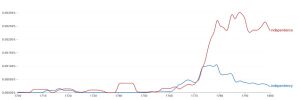
The very first printing of the Declaration on July 6, 1776, in The Pennsylvania Evening Post, simply repeats the title on the original. But in subsequent days, newspapers began to call the document the “Declaration of Independence,” as captured in this example from Pennsylvania Packet on July 8: “THIS DAY, at Twelve o’clock, the DECLARATION OF INDEPENDENCE, will be PROCLAIMED at the STATE-HOUSE.” And after 1776, “independence” became the coin of the realm, as captured in this graph of American English, 1700–1800, from the Google Books Ngram Viewer:
As a linguist, I am struck by other details in the original document. Are you wondering about all those “random” capital letters (which you see in Adams’s letters and the Constitution, too)? They are not as random as they might appear. In the 18th century, capitalization conventions were still settling down, and while everyone agreed that the first letter of a sentence should be capitalized, not everyone was on the same page about whether to capitalize important nouns. Some of the founding fathers, judging from their writing, were pro noun-capitalization.
In the opening lines, there is a lone “hath” (in “all experience hath shewn”), after which the list of grievances against the King of Great Britain employees “has” all the way through. In 1776, “hath” would have been archaic — although not for that long. Historical linguistic studies indicate that “has” passed “hath” in frequency in writing less than 100 years earlier. “Hath” likely endowed the document with a sense of legalistic formality, an elevated tone appropriate for a declaration of this kind. (The variation may also reflect multiple hands at work in the drafting and revising of the document.)
If you’re curious about “shewn” rather than “shown,” they were both available in American English at the time. The now archaic “shewn” doesn’t drop in usage until the second half of the 19th century.
The Declaration of Independence also contains spellings that now look British, such as this –our spelling: “He has endeavoured to prevent the population of these States.” Many of the spellings that now characterize American English — such as “theater” (vs. “theatre”), “realize” (vs. “realise”), “defense” (vs. “defence”), and “honor” (vs. “honour”) — were propagated by Noah Webster, who saw spelling reform as part of a patriotic project to establish an independent American version of the English Language. And when he published An American Dictionary of the English Language in 1828, it included both “dependence” and “dependency,” but there was no “independency” alongside “independence.”
Here in 2026, we can take for granted comprehensive English dictionaries, but these were still relatively new in 1776. Dictionaries, along with an explosion of English grammar books in the 18th century, were part of the bigger project of codifying the language, of trying to establish a uniform, “correct” way of using English — and trying to stop the language from changing. But a living language will always change. Even though the founding documents are still intelligible to us today, they carry clues to features of an earlier American English, spoken and written in 1776.
Anne Curzan is a Professor of English and Linguistics at the University of Michigan and a member of Planet Word’s Advisory Board. Her research primarily covers the history of English, language and gender, lexicography, and pedagogy.